
| CREEPINGNET SIXTENDER Now you can bring your vintage six switch Atari into the 21st Century wire-free! |
 In late 2024, I got my hands on Atari.SA's new CX-78+ wireless gamepads. Actually, it seems a lot of us Atari players got these devices for our old consoles around that time, and while they work great if you have a Light Sixer or newer console in practice, there are some problems with these versions of the Atari Video Computer System/2600...
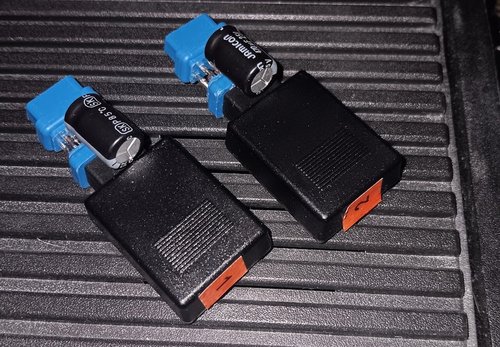
First off, the original Atari 2600 - the 1977-1978 "Heavy Sixer" variety have a very decorative back panel where the joystick ports are located, and these ports are inset and surrounded by very nice looking molded plastic trim in the back of the console. The unfortunate side effect of this is depending on which DB-9 joystick connectors your "Heavy Sixer" 2600 came with, you might just barely get the Wireless Dongles to fit just enough to work, or like me, you might end up with just the +5v and gnd lines being the only visibly working parts on your console at best...if they even fit at all. The second problem that plagues BOTH consoles, is that the "Sixer" (six switch models) models of the Atari 2600 have a CD4050 Hex Buffer chip inline with the joystick ports used for "debouncing" the fire button, as well as some additional purposes that contribute to these models hightly desirable video output because of the high, very sweet video saturation. The Woody, Vader, and Junior consoles, all don't have this problem due to changes in the circuitry in 1980. This hex buffer is a catalyst to the "music" or "noise" people get when the dongles are plugged in and working. YOu get this long sawtooth wave of noise that changes in pitch seemingly at random, and even causes some video interference. So for the last 2 years, I've been mucking about with a solution for this. I followed a very long (and occasionally verbally cranky) thread on AtariAge on it that almost has me scared to post more than my one post in the Atari 2600 group about this (theirs was in the 2600+ group).Other Solutions Most of the big arguements on the forum was from EE types (Eletronics/Electrical Engineers) was that it would not work for XX reason. But I'm one of those people who knows the old truth that "you never know for sure until you try". The problem seems to stem from a constant 5vdc pushed down the joystick lines causing the noise...my anti-braniac theory upon hearing someone with a scope or some other advanced Electronics Engineer equipment was that this was definatley a part of the cause. One of the first fixes was to remove the 5 volts from the ATari itself and run a regulated voltage to the dongle. While this indeed fixed the problem (makes sense, now the dongle is no longer powered by the Atari with it's noisy power) - the obvious issue is an external power source, which somewhat defeats the purpose of wireless controllers because now you're just exchanging the controller wire with another wire to power the dongle. Another fix I saw was cutting a trace on the motherboard (the main circuit board inside the aluminum box in the middle of the Atari where the Cartridge port is). The trace goes down the left side of the board (Facing the bottom, cartridge port toward the top), and has to be cut and then re-routed, but it seems this means altering the original board of a expensive late 70's Atari, and it also means if your wire placement isn't good you'll get some video interference. I've heard all sorts of craziness from armchair EE's ranging from "you need an Arduino" to "It's OOOOOOLD! Just buy a 2600+ and shut up!". Thing is, I'm not spending $100+ on a new Atari when I have TWO that work at home. I'm also not giving into this weird idea that "new" is better, as all over this site I'm citing cases where it is absolutley not.My Circuit My basic idea was to make something that requires zero alteration to the Atari. My idea was...build a basic DB9 passthrough, then focus on filtering out the power circuit like I would one of my guitar pedals. Guitar Pedals often use filtering in the power to get rid of noise in the guitar signal....so why not do so with an Atari 2600. Filtering is usually done with an electrolytic capacitor, and maybe even some smaller value caps in ceramic or some other. In pedals, this often removes noises from the pedal's power circuit. One clue was a guy on AtariAge was saying there was a steady 5v signal creating the noise. Well, 5v IS the exact voltage that is sent to the Joystick port, and it's typically used for the Paddle Controllers (which are just 1 MEG Ohm pots like you'd find in any Fender Jaguar or Jazzmaster electric guitar). The +5 also shares a power supply with one component the "Sixer" consoles have that no other console in the CX-2600 line has - A CD4050 Hex Buffer....do you see where I'm going with this? Now, I know for a fact, I've used Hex Buffers, such as the CD4060, the CD4050, or CD40106 to create DIY Synthesizer oscillators. They also work GREAT for amplification of a signal or distorting it as well (which is what they do in my guitar synth pedal)...so knowing there's some signals that could be leaking over, maybe even a mere overpowering of the .....maybe we can filter those out via the filter caps. I've also used filter caps to somewhat "gate" a fuzz pedal before, so time came for the experiment... I bought a little 5 pack of DB9 female/male pairs on E-bay, took two of them, wired them straight through, then used pliars to cut the metal surrounds off each end so they'd just be the blue connectors + the pins, and nothing to stop it from fitting a Heavy Sixer - which was one of two goals. REduce noise, make the dongles fit ANY Heavy Sixer. Now, I brought the dongles to the livingroom, moved my Heavy Sixer over to the TV, plugged it in, plugged in the Dongle with the Atari wireless attached, and then took my little plastic bin of Capacitors, and started working with the center 2 bottom leads on the dongles which are GND and +5V DC. I tried multiple capacitors, starting with a 10uf since I see those the most in power conditioning, but it wasn't enough, but got pretty close. So I had a pair of huge 470ufs laying around and stuck one on the Player 1 port, and bye bye noise...well, it's still occasionally very very faintly audiable in some games and some scenarios. It's not consistant, but it still gets about 90-97% of the way there, sometimes 100%. My next part of development, is I still get some very very faint noise on certain games and in certain situations, so I'm thinking I'm going to double up on a smaller non-polarized capacitor in parellel to trim out the higher frequencies. My goal is dead silence if I can get that far. |


